
Cyclonic storm Fengal has commenced making landfall close to Puducherry and it may approximately take 4 hours for it to cross the coast completely, an India Meteorological Department (IMD) official said. The process of the cyclone's landfall commenced at about 5.30 pm on November 30. The IMD said the forward sector of spiral bands associated with the cyclone has entered into the land and is likely to move west-southwestwards and cross north Tamil Nadu-Puducherry coasts between Karaikal and Mahabalipuram close to Puducherry as a cyclonic storm with a wind speed of 70-80 kmph gusting to 90 kmph during next 3 to 4 hours.

Temperatures in 17 locations breached 45 degrees Celsius on Monday, with the punishing heat affecting health and livelihoods.

Taking to Twitter, the Delhi Traffic Police asked commuters to take the alternate route.


The IMD said that rainfall over India in August and September would be around 106 percent of the long-period average of 422.8 mm.

Heatwave conditions are expected over northwest India during the next five days, with Punjab, Haryana, Rajasthan and Delhi predicted to bear the maximum impact, the India Meteorological Department (IMD) said on Thursday.

'The intensity and frequency of heatwaves will be much higher than in previous years over Punjab, Haryana, Rajasthan, Gujarat, Madhya Pradesh and Odisha.'

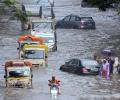
The India meteorological department's Mumbai centre has predicted heavy to very heavy rainfall in the city and suburbs in the next 24 hours, with a possibility of occasional gusty winds reaching 50-60 kmph, the official said.

He said scientists have noticed a trend of very deep cloud systems developing over the southeast Arabian Sea, and added that sometimes, these systems intrude into the land, like in 2019.

"This year, the Southwest Monsoon is likely to set over Kerala on May 31 with a model error of four days," the India meteorological department said on Wednesday.

In view of the safety of the passengers, the district administration stopped the passengers at Sonprayag and Gaurikund due to continuous bad weather.

The southwest monsoon is likely to hit the Kerala coast around June 1, well within its normal date of arrival, the India Meteorological Department (IMD) said.

The average temperatures observed pan-India for April was 35.05 degrees, which was the fourth highest in 122 years.

India is likely to witness normal rainfall during the southwest monsoon season this year, the India Meteorological Department said on Thursday. Rainfall will be 96 per cent to 104 per cent of the Long Period Average (LPA) of 87 cm of the 1971-2020 period, it noted. Earlier, the IMD used to consider the LPA of 88cm of the 1961-2010 period.

Disaster management authorities have warned about very heavy rainfall over the next 24 hours.

The four-month monsoon season from June to September accounts for 75 per cent of rainfall in the country.

Heavy rains in Bengaluru on Wednesday night resulted in waterlogging, incidents of tree fall, damage to certain infrastructure and power outage in several parts.

>Bihar (18 days) has the most number of heatwave days in 2023, followed by Andhra Pradesh (15 days), Odisha (15 days), Jharkhand (13 days), West Bengal (8 days) and Tamil Nadu (6 days).

There were no reports of loss of property or life.

The situation in rain-battered Gujarat improved slightly on Thursday as the rainfall activity subsided, but Vadodara and some other parts of the state are still reeling under a flood-like situation due to overflowing rivers while the authorities continue the rescue and relief operations.

As heavy rains continue to lash Kerala, the India meteorological department on Friday issued an orange alert in eight districts in Kerala for Friday.

Heavy rain in the first week of July compensated for the shortfall but caused flooding in many northeastern states.

It is in more than a decade that the IMD has predicted 'above-normal' rains in the country.

The India meteorological department has stated that day temperatures are likely to be above normal by 0.5 degree Celsius, reports Sanjeeb Mukherjee.

Conditions were becoming favourable for further advance of the southwest monsoon over some more parts of the south peninsula and east India and adjoining areas between June 18 and 21.

Mumbai, its satellite cities, north and central Maharashtra and south Gujarat received rains on Wednesday owing to a low-pressure area in the Arabian Sea and a western disturbance, the India meteorological department said.
A civic volunteer, identified as Chandan Das (31), died on the spot when he allegedly touched a live wire in Bud Bud in Purba Bardhaman district. The incident happened when he was out with a police team, they said.
On May 15, the weather office had announced the onset of monsoon over Kerala by May 31.

Even as Mumbaikars got some respite from the downpour on Friday morning, the India meteorological department has issued a red alert for the city and its suburbs warning that very heavy to extremely heavy rainfall is likely at isolated places during the day, the civic officials said.

The arrival of the wet season that is crucial to farmers in India.

The Met Office has issued a yellow alert, warning of moderate rain which could cause more problems to the residents of Delhi.

The unrelenting heatwave sweeping large parts of the country has claimed at least 110 lives and left over 40,000 people grappling with suspected heatstroke between March 1 and June 18 this year, health ministry sources said on Thursday.

This would be the second cyclonic storm in the Arabian Sea this year.

June rainfall accounts for 15 percent of the total precipitation of 87 cm recorded during the four-month monsoon season in the country.

This is for the second time this month that Mumbai has recorded the highest maximum temperature in the country.

With the prediction of an above normal monsoon in 2024, the government is expecting food prices to come down, the finance ministry's monthly economic report for March has said. The report, released on Thursday, said robust foreign inflows and comfortable trade deficits were expected to keep the rupee within a comfortable range. "Further easing of food prices is on the anvil as IMD (India Meteorological Department) has predicted above-normal rainfall during the monsoon season, which is likely to lead to higher production, assuming good spatial and temporal distribution of the rainfall," the monthly report, released by the Department of Economic Affairs, said.

BMC officials will hold a meeting through video conferencing with representatives of India Meteorological Department, and the Indian Institute of Tropical Meteorology and Mekorot officials on Thursday to draw an action plan in this regard. The move comes at a time when Mumbaikars are suffering from water cuts due to deficient rainfall.

Northwest, central and east India are predicted to record maximum temperatures three to five degrees above normal over the next five days, the India meteorological department (IMD) said on Thursday.

The current spell of weak monsoon over the country is likely to continue for the next five days, the India Meteorological Department (IMD) said on Wednesday.
